Design – Build – Custom – Homes – Renovations – Additions – Remodels

If you are looking at land around Lake Anna, you will probably run into the phrase “perc test” before long. Listings mention it. Realtors ask about it. And if you are like most of the buyers we talk to, especially those coming from Northern Virginia or Richmond where public sewer is the norm, it may be a new term.
This is a plain-English explanation of what it is, how the process works in Virginia, and how to get one done. We build most of our homes on well and septic, so this comes up on nearly every project we take on.
“Perc” is short for percolation. A perc test measures how quickly water drains through the soil on a specific spot of a specific lot. That matters because a septic system works by letting treated wastewater soak into the ground through a drainfield. If the soil drains too slowly (heavy clay, for example) or too quickly, or if there is rock or a high water table close to the surface, a standard drainfield may not work there.
In everyday conversation around here, “perc test” usually means the whole soil evaluation, not just the timed water test. In Virginia, that evaluation is done by a licensed Onsite Soil Evaluator (an OSE) or a professional engineer. They look at the soil profile, the slope, the drainage, the setbacks from wells and property lines and the water, and they work out whether a septic system can go on the lot, what kind, and where.
The result is typically one of three things: the lot supports a conventional septic system, the lot supports only an alternative system, or the lot does not support a septic system at all in the area evaluated.
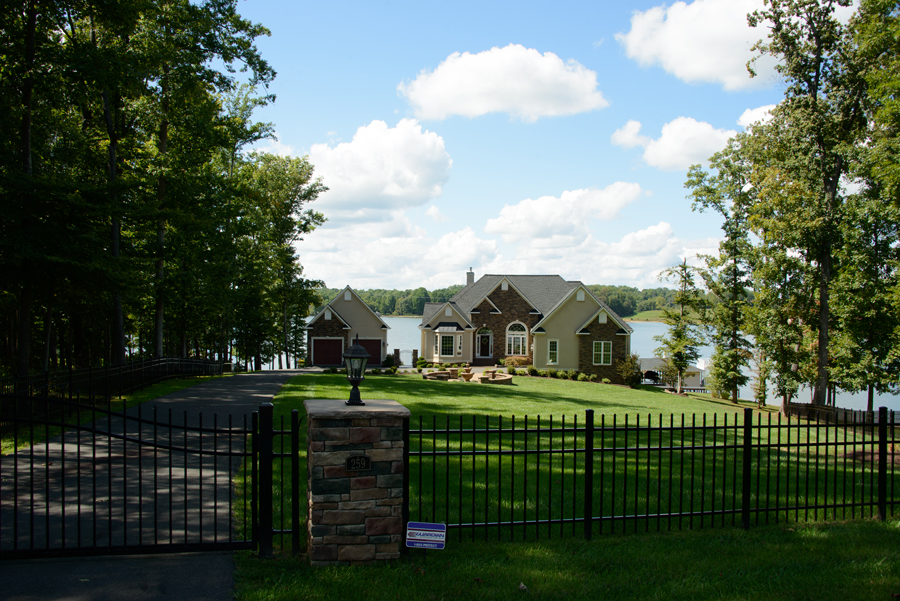
Outside the town centers, most of the land in Louisa, Spotsylvania, and Orange counties has no public sewer. A house on that land needs its own septic system, and the system has to be permitted before the house can be built. So for a large share of the lots around the lake, the soil evaluation is a step that happens whether the buyer thinks about it or not. The only question is whether it happens before or after you own the lot.
Lake Anna lots also tend to have the conditions that make the evaluation matter: slope toward the water, clay in pockets, and shoreline setbacks that shrink the area where a drainfield can go. Two lots that look the same from the road can come back with very different results.
Virginia’s health department defines a conventional onsite sewage system as a septic tank with gravity, pumped, or siphoned flow to a gravity drainfield. It is the simplest and generally the least expensive setup, and it is what most people picture when they hear “septic.”
When the soil will not support a conventional system, the state allows alternative onsite sewage systems, usually shortened to AOSS. These add a treatment unit and often a pump chamber and a different kind of absorption field (a drip system, a mound, a sand filter, and so on). They are designed by a licensed OSE or engineer for the specific lot.
One thing that is a legal requirement, not a suggestion: under Virginia’s AOSS regulations, the owner of an alternative system must have it operated and maintained by a licensed operator, keep the operation and maintenance manual and the operator’s log on the property, and pass them along to a future owner. So an alternative system is not only a higher upfront cost; it comes with an ongoing service obligation. That is worth knowing before you settle on a lot, because it is a difference you will live with for as long as you own the home.
The steps are fairly standard across the state. The specifics of who you call vary a little by county.
In Virginia, applications for an onsite sewage system or private well have to be accompanied by supporting work from a private consultant licensed through the Department of Professional and Occupational Regulation (DPOR). In practice, that means you hire an OSE or a professional engineer to do the site and soil evaluation and, if the lot passes, to design the system. The health department only does the evaluation itself for owners who qualify under its hardship or means-tested guidelines.
You can verify a consultant’s license on the DPOR website, and the Virginia Department of Health keeps a map of providers who have shared their contact information. Neither list is an endorsement, but they are a reasonable place to start.
The evaluator comes out to the lot, reviews soil mapping and health department records, and digs test holes (by hand auger or with an excavator, depending on the site) to look at the soil layers. On a sloped Lake Anna lot the evaluator is also mapping where a drainfield could physically fit once the setbacks are accounted for.
For a rough sense of cost, one Virginia soil consulting firm published a range of about $200 to $3,000 in 2025, with hand-dug evaluations at the low end and excavator work on difficult sites at the high end. Your number will depend on the lot, the soil, and how much design work is included, so treat that as a ballpark rather than a quote.
Once you have the evaluator’s report and design, you submit the state application form, the fee, a plat of the property, and a site sketch showing property lines, the proposed house, and the proposed well and septic locations to your local health department office. For lots in Louisa County, the county directs well and septic questions to the Louisa office of the Virginia Department of Health on Industrial Drive in Louisa. Orange County lots go through the Rappahannock Rapidan Health District, and Spotsylvania has its own local office. You can check application status through the state’s online permit portal.
If the application is approved, you get one of two things, and the difference matters if you are buying land you do not plan to build on right away.
If a seller tells you a lot “has a perc,” it is reasonable to ask which of these they mean and how old it is. An 18-month permit from several years ago is no longer valid. A certification letter is.
The septic design is sized for the house that will sit on the lot, so the evaluation and the house plan are connected. If you already have a plan in mind (we wrote about how to choose between plan types recently), it helps to have it in hand when the evaluator visits. If you are still deciding, the evaluation can tell you what the lot will support, which sometimes narrows the plan choices before you spend money on drawings.
This is also where we usually get involved. The soil report drives the foundation on every house we build, not just the septic. Clay shows up in pockets across Spotsylvania, Orange, and Louisa counties, and a foundation on a clay lot is detailed differently than one on a sandy or rocky lot. So the same evaluation that tells you where the drainfield goes tends to tell us a good deal about what the house will need underneath it.
Buying before testing. Nothing in Virginia law requires a perc test before a land sale. The health department itself notes that it does not require any activity in connection with buying or selling property with a septic system. That said, if a lot has not been evaluated, you are buying without knowing whether, or how, it can be built on. Many buyers make the contract contingent on a satisfactory evaluation. We would generally suggest at least asking.
Old results. Soil does not change much, but regulations, setbacks, and the size of the house you want to build can. An older evaluation is useful background, and it may still support a certification letter, but it is worth confirming with the health department rather than assuming.
Lots that fail. A lot that does not support a conventional system is not necessarily unbuildable. An alternative system may work, and the evaluator can usually tell you whether that is realistic and roughly what it involves. It changes the budget and the maintenance picture, so it is a good thing to learn early.
Where the well goes. The well and the drainfield have to keep a set distance from each other and from the property lines and the water. On a narrow or steep lakefront lot, those setbacks sometimes decide where the house can go more than the view does. The evaluator and the builder should be looking at the same sketch.
Our turnkey pricing includes clearing, excavation, the well, and the drainfield. What we cannot do is price a drainfield we have not seen a soil report for. So when a buyer comes to us with a lot that has already been evaluated, the starting budget is tighter and the conversation is shorter. When the lot has not been evaluated, that is usually the first thing we help arrange.
If you are looking at land around Lake Anna (we keep a list of lots for sale on the site) and are not sure where a lot stands, we are glad to look at it with you. Our model home and design center is on Route 208 near Lake Anna Winery, just outside Mineral. Reach us through the contact page or call (540) 895-9966.
Notifications